Why Crypto Press Releases Don’t Show on Google in 2026, and How to Fix It
You paid for a press release, the outlet sent you a live link, and the page is there. But when you search for it on Google, nothing comes up.
This is one of the most common problems in crypto PR, and it became more common in 2026, when several large crypto news sites lost most of their Google visibility. Their pages stayed online, so releases published there looked fine to the client, but almost no one could find them through search.
The cause can usually be identified in a few minutes. This guide explains how to check a release, why crypto press releases fail to appear on Google, and what you can still do about it. It’s written by the team at Rankovate, a crypto press release distribution and AI search optimization agency for Web3 projects.
Short answer: A crypto press release usually fails to appear on Google for one of four reasons: the outlet has lost Google’s trust, identical copies were published on too many sites, it was placed on low-quality sites Google rarely indexes, or it contains no real news. A site: search, an exact-headline search and a quick check of the outlet will tell you which one applies.
How Do You Check If a Crypto Press Release Is Indexed on Google?
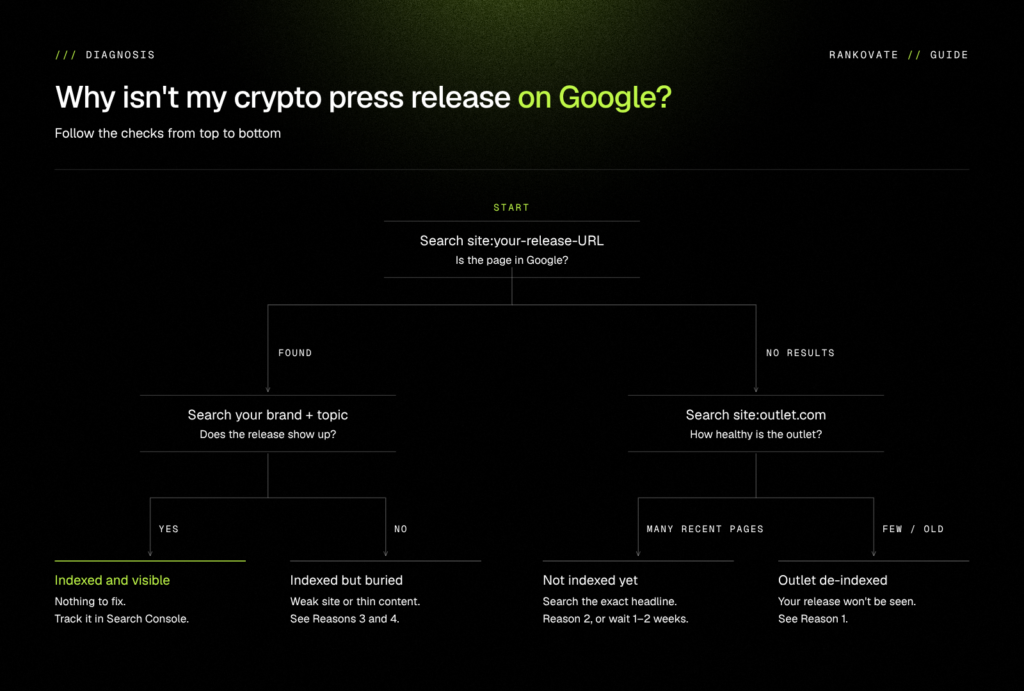
“Not on Google” can mean three different things: the page was never indexed, Google kept a different copy, or the outlet itself has dropped out of search. Each one has a different fix, so start by finding out which one you’re dealing with.
Step 1: Search for the exact URL.
Paste the full URL of the release into Google with the site: operator:
site:examplecryptonews.com/press-release/your-release-titleOne result means the page is indexed. No results means it isn’t.

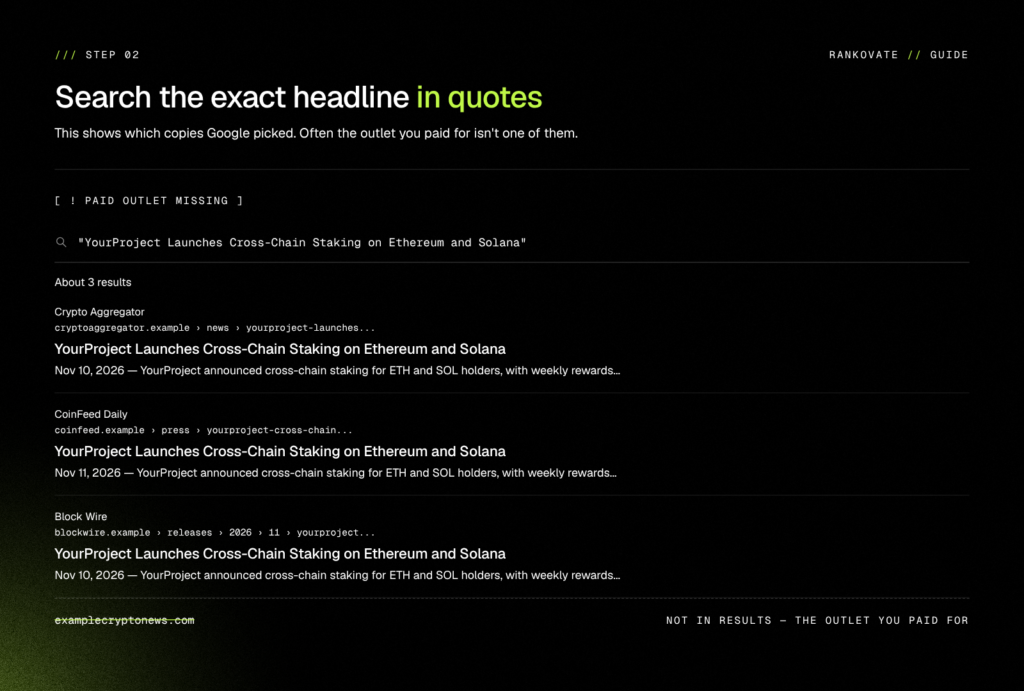
Step 2: Search for the headline in quotes.
"YourProject Launches Cross-Chain Staking on Ethereum and Solana"This shows which copies of the release Google has chosen to keep. It’s common to find the release on one or two syndication sites while the outlet you paid for doesn’t appear at all.
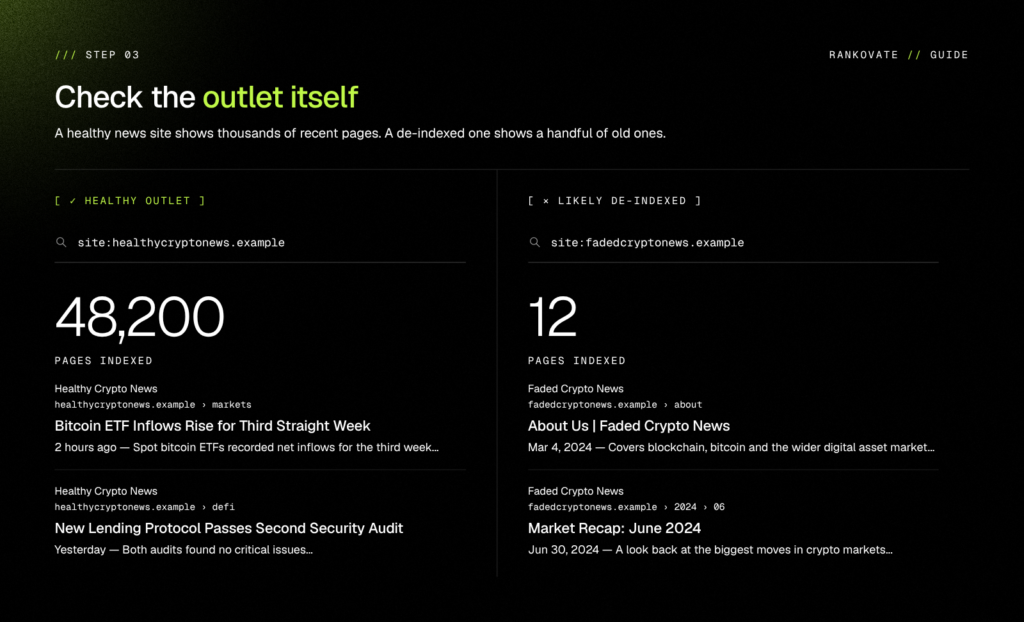
Step 3: Check the outlet itself.
Search site:outletname.com. A healthy news site returns thousands of pages, many of them published in the last few days. If you see only a handful of old pages, the outlet has likely lost its place in Google’s index, and every release on it has gone with it.
If the release is also on your own website, you can skip the guesswork for that copy. Paste its URL into the URL Inspection tool in Google Search Console, which shows whether the page is indexed and, if not, why.
| What you see | What it means | What to do |
|---|---|---|
| No result for the URL, but the outlet looks healthy | The page isn’t indexed yet, or Google chose not to index it | Wait 1–2 weeks, then see Reasons 2–4 |
| The headline appears, but only on other sites | Google kept a syndicated copy instead | See Reason 2 |
The outlet shows very few pages in a site: search | The outlet has lost Google visibility | See Reason 1 |
| The page is indexed but doesn’t rank for your brand name | Indexed but buried: low trust or weak content | See Reasons 3 and 4 |
Rather not check it yourself? Send us the links to your release and we’ll run these checks for you. You’ll get a free report showing which placements are indexed, which outlets have lost Google visibility, and what to do next. Get a free indexing check →
Why Isn’t My Crypto Press Release Showing on Google? 4 Reasons
1. The outlet has lost Google’s trust
A press release can only be as visible as the site it’s published on. If Google stops trusting an outlet, every page on it loses visibility, including the release you paid for. This is the biggest change of the past year, and most PR packages still don’t account for it.
One of the largest crypto news sites shows how quickly this can happen. Third-party estimates put its US Google traffic at about 5 million monthly visits in mid-2025. By May 2026 it was close to zero, and most of the drop happened within a single month. Google never confirmed a penalty, but the site ran a large sponsored section, the kind of content Google’s site reputation abuse policy targets. Several other well-known crypto outlets lost most of their search visibility over the same period, while their pages stayed online and they kept selling placements.

Site reputation abuse is Google’s term for third-party content placed on a trusted site mainly to benefit from that site’s ranking signals. Paid and sponsored sections are a common example. Since August 30, 2026, Google no longer applies these manual actions for searchers in the EU and EEA, but they still apply in the US, the UK and other markets.
The practical lesson: a well-known name or a high Domain Rating doesn’t tell you whether an outlet is visible in Google today. Check before you pay.
Looking for outlets that Google still indexes? Rankovate’s media list shows each outlet’s traffic, Domain Rating and indexing status. Tick Usually Google Index at the top of the list to see only the outlets whose pages Google usually indexes. Open the media list →
2. Identical copies are published across dozens of sites
Most distribution packages publish the same text on 50, 100 or even 300 sites. Google treats these as duplicates of one article, so it usually indexes one or two copies and ignores the rest. The copy it keeps is usually the wire’s own page or one large site, not the outlet you paid the most for, and sometimes it keeps none of them.
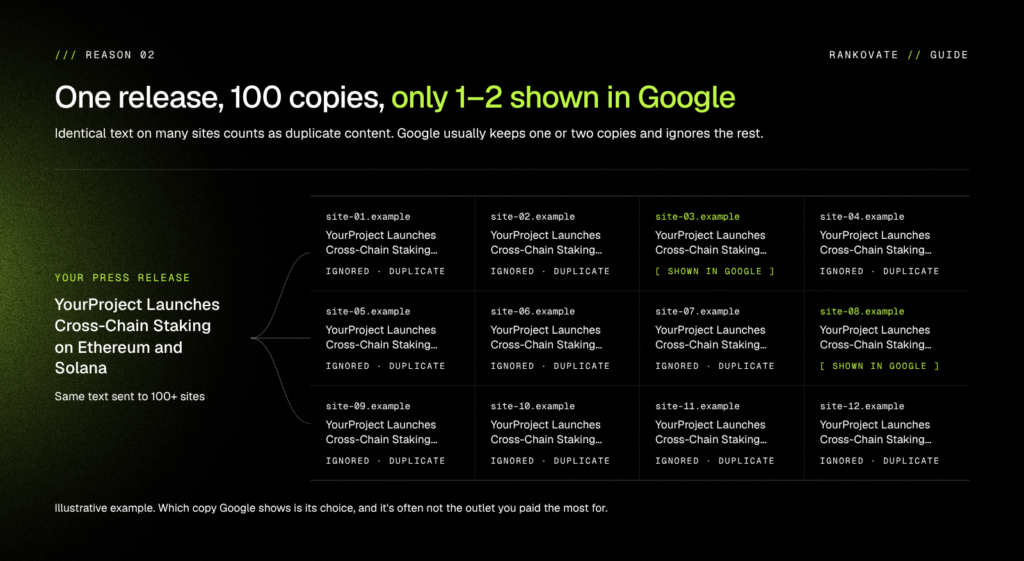
What we found: We checked 14 crypto press releases distributed by a major crypto newswire in late 2026. Each one was syndicated to a long list of sites, yet a normal Google search showed only about 1.4 copies per release on page one, and none at all for one release. The project’s own website appeared on page one for 9 of the 14. What decides visibility is which outlets carry your release and where the full version lives, not how many sites it reaches.
3. The release is placed on low-quality sites
Cheaper packages often fill their outlet lists with low-traffic sites that Google rarely crawls and doesn’t trust. A release on one of these sites may never be indexed, and even if it is, it’s unlikely to rank. A long list of outlets looks good in a campaign report, but it adds little search visibility.
4. The release has no real news
Google’s ranking systems are designed to favor content that’s useful to readers. A release built on words like “revolutionary” and “game-changing”, with no verifiable facts, gives Google little reason to index or rank it. Releases that do get picked up tend to include specifics: a launch date, a figure, a named partner, a working product, a quote that says something.
A simple test: if you could swap in another project’s name and the release would still make sense, it’s too thin.
What Can You Do If Your Press Release Is Already Live?
A distribution can’t be undone, but a few steps still improve the odds of being found.
- Publish the full release on your own site. A newsroom or blog page on your domain is the one version you control. Add something the syndicated copies don’t have, such as a chart, a short FAQ or extra detail, so Google has a reason to treat it as the main version.
- Link to that page. Link to it from your homepage, your documentation and your announcement posts on X, Telegram and Discord. Internal links and real visits help Google find the page and judge it as important.
- Ask your distributor which URLs are indexed. A reliable provider can tell you which placements are live and which are in Google’s index. If most of them aren’t indexed, you know which outlets to avoid next time.
- Request indexing once, then stop. Requesting indexing for your own page in Search Console is fine. Resubmitting the same URL again and again, or paying a service to do it, won’t change Google’s decision about a page it has chosen not to index.
How Do You Get a Crypto Press Release Indexed on Google?
There’s no shortcut. What works is choosing outlets carefully, publishing in the right order and giving Google something worth indexing.
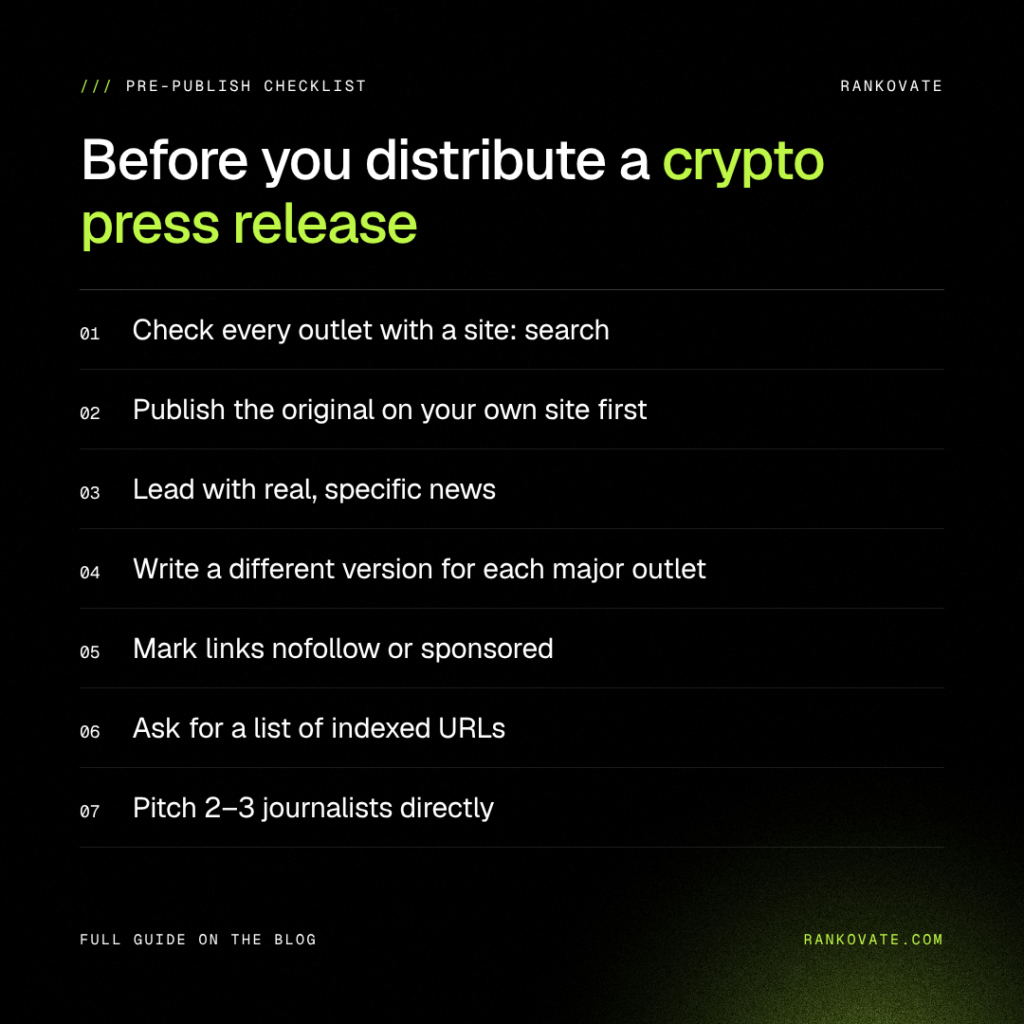
1. Check every outlet before you pay. Run a site: search for each site on the package list. Remove any outlet that shows only a handful of old pages, and ask the provider for a replacement.
2. Choose fewer, stronger outlets. Five placements on indexed sites your audience actually reads will do more than 200 on sites Google ignores. Ask for recent traffic figures, not just Domain Rating. A good Web3 PR agency should be able to show you which of its outlets are indexed today.
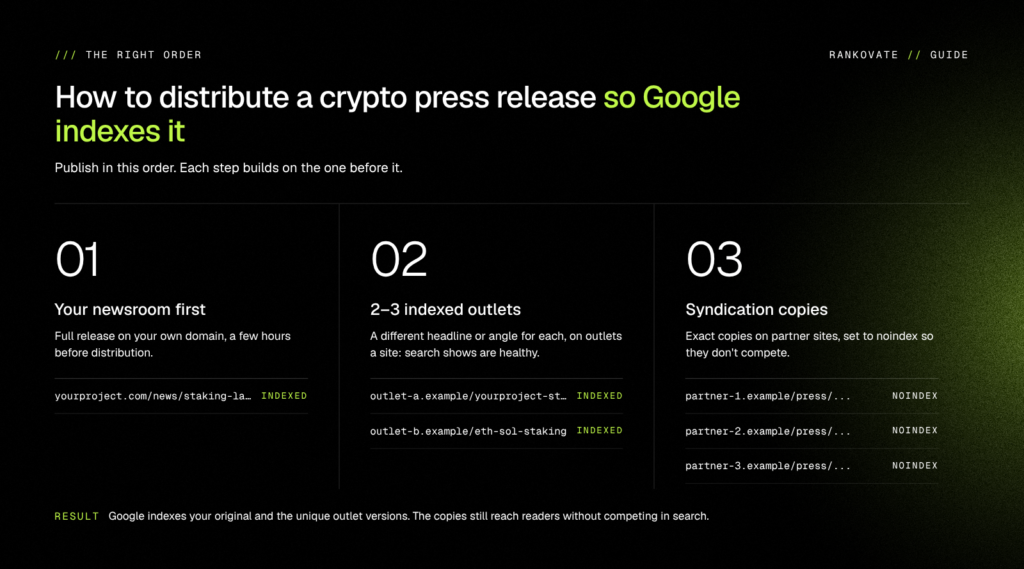
3. Publish the original on your own site first. Put the full release on your newsroom page a few hours before distribution, so your version is online before the copies appear.
4. Write a different version for each major outlet. If the release is going to two or three major sites, change the headline, intro or angle for each. Distinct pages are more likely to be indexed separately than identical copies.
5. Ask syndication partners to noindex exact copies. This may seem counterintuitive, but it follows Google’s own guidance. Google no longer recommends canonical tags for syndicated content and says the most effective option is for partners to block indexing of their copies. Ask them to add this tag to the <head> of their copy:
<meta name="robots" content="noindex, follow">This keeps the copy out of search results while search engines still follow its links back to your original. If a partner only wants to hide the copy from Google, <meta name="googlebot" content="noindex"> does the same for Google alone. Never add either tag to the original on your own site, or it will disappear from search too. Not every network will agree to this, but it’s worth asking.
6. Lead with facts. Say what launched, when, for whom and with what numbers. Include one quote that adds information rather than enthusiasm.
7. Pitch journalists directly. When a reporter writes their own article about your news, it creates a unique page on a trusted site, which is exactly the kind of page Google wants to index. Send the release to two or three reporters who cover your niche, with a short personal note.
Related guides: Before you distribute, run through our crypto press release checklist, see how to write a Web3 press release, and compare crypto PR distribution vs guest posting.
Do Indexing Tools and Backlink Tricks Work?
Paid “indexing services” are a common reaction when a release doesn’t appear. They ping Google repeatedly or push the URL through networks of low-quality pages. At best, a weak page gets indexed for a short time. That doesn’t make Google trust the page or rank it.
Keyword-rich links inside the release don’t help either. Google’s spam policies have treated links with optimized anchor text in widely distributed press releases as a link scheme for more than a decade, and at scale they can do harm.
Be cautious, too, with any provider that guarantees Google News placement or first-page rankings. No one outside Google controls either of them.
Frequently Asked Questions
How long does it take Google to index a press release?
On a large, healthy news site, usually within hours to a few days. On smaller sites it can take weeks, or not happen at all. If a release still isn’t indexed after two weeks, run the three checks above rather than waiting longer.
Why is my press release on Google News but not in regular search?
Google News and web search select pages separately. A release can appear in News while it’s fresh, then drop out of web results when Google decides another copy, or another page, is more useful.
Do crypto press releases still help SEO?
Not much directly. Links in press releases should be marked nofollow or sponsored, so they ot pass little ranking value. The benefit is indirect: more people searching for your brand, coverage from journalists, and mentions on sites that readers and AI tools trust.
Will my press release appear in ChatGPT or Google AI Overviews?
Only if it’s indexed on a trusted site. AI search tools mostly draw on pages that are already in search indexes, so a release on a de-indexed outlet is unlikely to be cited. Clear facts, a short summary near the top and placement on indexed outlets improve the chances. Optimizing for these tools is often called GEO (Generative Engine Optimization).
Final Thoughts
When a crypto press release doesn’t appear on Google, the reason is rarely a mystery. Three quick searches will usually show whether the problem is the outlet, duplicate copies, weak placement sites or the release itself.
The projects that stay visible are the ones that check outlets before paying, publish their own version first, and give journalists and Google something worth covering.
Planning your next release? Rankovate helps Web3 projects with crypto PR and AI search optimization: choosing outlets that are still visible on Google and in AI search, and checking every placement after it goes live. Start with a free indexing check of your last release, or tell us about your next launch. Talk to Rankovate → or message us on Telegram.